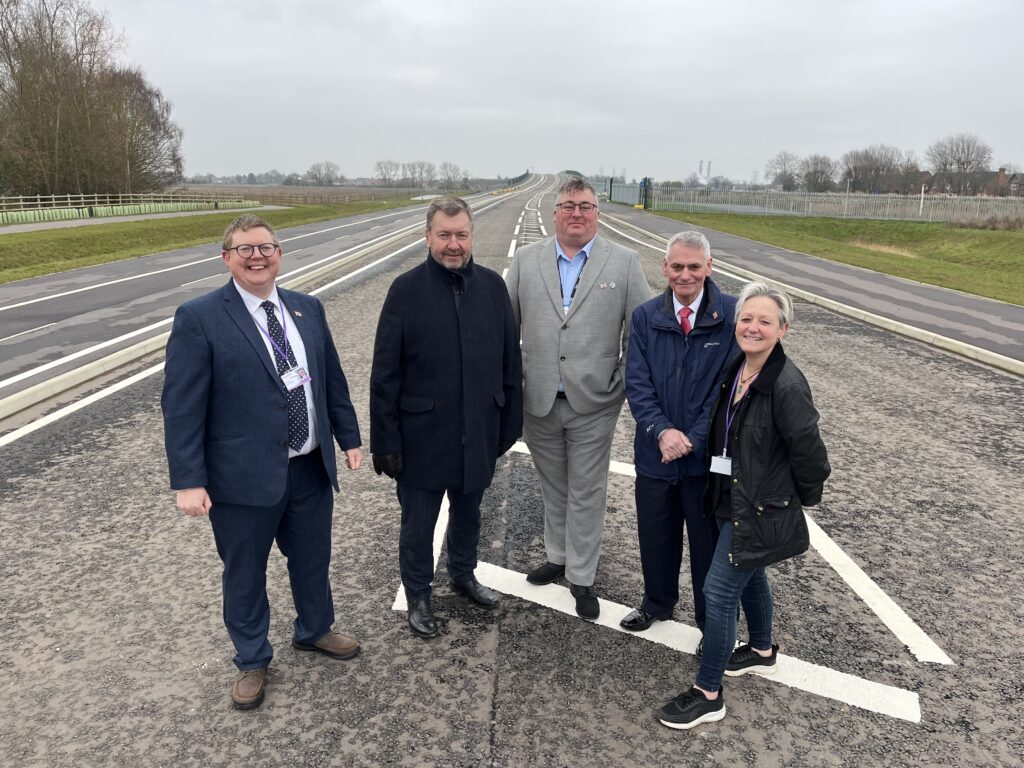
Bids have gone in to help fund the Spalding Western Relief Road’s most southerly section ahead of applications for 4,000 more homes that would open the current ‘road to nowhere’.
Lincolnshire County Councillors leader Sean Matthews and deputy leader Rob Gibson said they have made finishing the one fifth built road a priority despite the cost of it having almost doubled to £200m.
The £27,7m funding that was last year allocated away from the project to a similar relief road in Lincoln has been reinstated for Spalding.
And Coun Gibson said bids for grants had been made to Department for Transport and the Ministry of Housing, Communities and Local Government to help fund the southern section alone which is now expected to cost £60m.
When work began on the most northern section the whole scheme was expected to cost £109m.
The three middle sections are now estimated to cost £30m each.
The first section was built for £50m but remains unopened to the public.
Coun Gibson though said that it could be opened up when ‘we receive the confirmation the first houses are going to be built’ from applications for around 4,000 homes expected to be submitted in the next few weeks.
The Section 106 money from such developments has been identified to fund section two while section four is now set to built by developers, the county council say.
“The Spalding Western Relief Road is supposed to be here to provide relief for Spalding and the train lines are down and people are stuck,” said Coun Gibson. “The mayor is working with us to try and achieve more funding to get the road built as well.
“If we leave this for years and years it will become too much and unachievable.
“If we’re going to do it, lets do it and get on with it.”
Planning permission for the southern section was granted in 2019.
Edwards, head of Highways said it would be a ‘mirror image’ of the northern section.
When asked what measures had been taken about the middle sections to ensure the southern section was not just another ‘road to nowhere’ Coun Gibson said the authority was going to start drawing up plans for section two which would link the southern section with Bourne Road.
“We’re working with every single department, every government department, the mayor’s office. We are doing everything we can do.
“We’re here to say we’re pushing forward and as hard as possible.
“We’re going to start with the planning applications for section two, the developers can get on with section four, and then it’s a case of lets get on with it.
“Once we get to that stage we’re going to be a few steps down the road.”
One other important aspect of the relief road is that the costs of the middle sections are based on recovering Section 106, a legal agreement with a developer that it be allowed to build provided it gives money towards the community.
In the last few years many developers have tried to get out of paying this providing ‘viability studies’ that show they won’t make enough of a profit.
Sam Edwards, Lincolnshire County Council’s head of Highways, said the balance of delivering housing and the road was a ‘chicken and egg’ and had to be delivered with housing rather than being fully funded because ‘it’s going to struggle on a benefit to cost ratio purely on Highways.’
Officials say getting more Section 106 money for the relief road will remain a priority.
South Holland District Council’s officer for highways and infrastructure Paul Jackson said: “We’ve always sought to make the relief road the priority.
“The houses we’ve delivered so far have already delivered that money, it’s over £1.5m already in the district council’s bank.
“We’re pretty confident the relief road will continue on that model.
“Probably over time the costs will have to be reapraised and I suspect we’ll get more money rather than less.”
Coun Gibson said: ““Residents will say this is 10,000 houses, where is the doctors, the dentists, the shops etc.
“We can’t do both. The relief road has got to be the priority. We’ve got to get this finished.”
Coun Matthews added: “If the doctors are needed then the NHS can say we need a new surgery and we’ll talk about it then, but the reality is that it’s the road and the houses we are concentrating on.
“If shops are needed because of the fall they will come naturally from businesses.”
The need to build housing alongside the road is why the county council has bid for money from the ministry responsible for housing as well as for transport.
“They’ve got ambitious house building targets and if they want to achieve them they could achieve something here in Spalding,” said Coun Gibson. “It will help with the government targets.