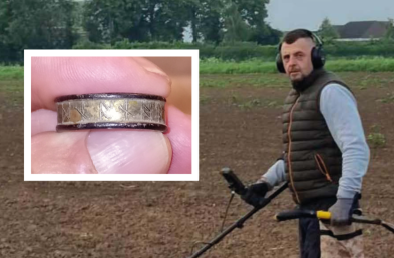
The discovery of a ring more than 1,000 years old in a field in Quadring has left experts baffled.
Metal detectorist Rafal Weslowski uncovered the ring with other artefacts 2024.
The silver gilt ring has been dated as being from the eighth to tenth century (700-1,000AD).
It also has 16 runic engravings on it, similar to two others that have been found, one in Cumbria and one in County Durham which is on display in the British Museum.
That institution’s Probable Antiquities Scheme recently listed the item as ‘subject for consideration as a treasure’.
Research carried out by archeologists at the University of Nottingham says that the runes may spell out something like ‘Udna’s ring’, possibly ‘highest ring’.
“All of these take Udnan as a personal name, which is far from certain,” the entry to the scheme states.
Rafal, who lives in Boston, has been metal detecting for around three years and is with a group known as the Maniac Squad.
He told The Voice that experts he’d spoken to had linked the interpretation of the runes to Udie, a name with early Germanic/Anglo Saxon connotations that refers to wealth or fortune.
A late Anglo Saxon buckle is another of Rafal’s finds from nearby.
“I’ve always loved history and started metal detecting after watching a few videos on You Tube,” said the 49-year-old who works as a butcher. “As soon as I saw the ring I knew instantly it was something interesting with its markings.
“I’ve had lots of finds so far after asking for permission to look in fields around Surfleet, Quadring, Donington and Gosberton.
“There’s been 140 coins so far with artefacts dating back to the Anglo Saxons and the Vikings.
“I must be either very lucky or there’s lots of good stuff in these fields that haven’t been searched often before.”
Lincolnshire County Council’s Lisa Brundle said there’s evidence of Medieval and earlier settlements in the area on higher ground amid the Fenland marshes of the time.
“The Quadring finger ring represents an important contribution to our understanding of this period, with only a handful of runic‑inscribed objects currently known, and helps to piece together another strand of the emerging story of life in the marshland landscape,” she said.